PREFACE
A Different Kind of Proof
There are two ways to believe in God.
The first is pure faith — a feeling in the chest, a certainty that cannot be explained, only felt. This is valid. Billions of people across all of human history have lived and died by it, and no argument in this book diminishes the power of that conviction.
The second way is to look at the universe itself — to examine the numbers, the physics, the biology — and follow the logic wherever it leads. This book takes the second path. Not because faith is insufficient, but because for those who need more than faith, the universe itself has already made the case.
We will use no religious texts in our core argument. We will use mathematics, physics, biology, neuroscience, information theory, and clinical medicine. We will follow the numbers. And the numbers will take us to the same place that faith always has.
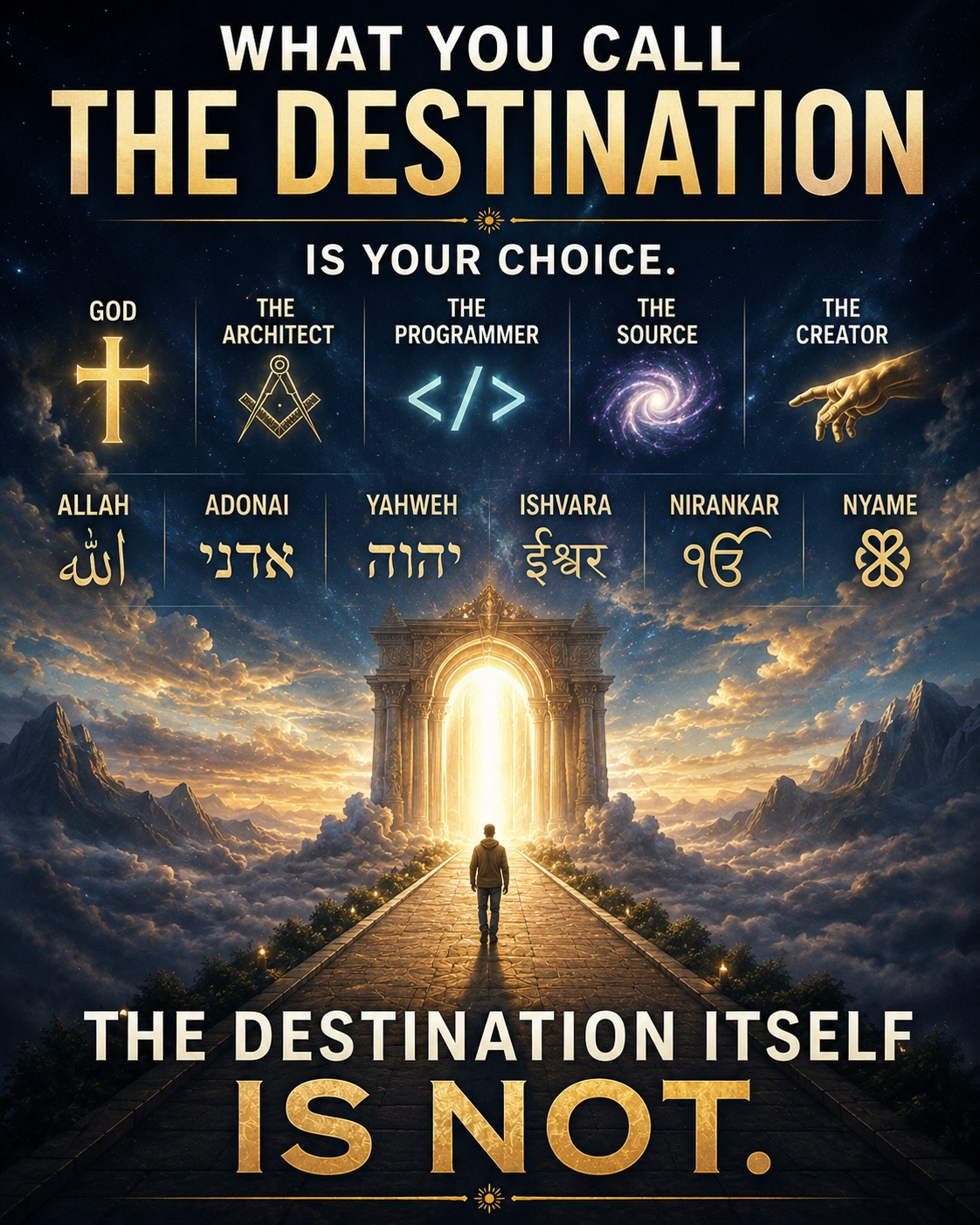
What you call the destination — God, the Architect, the Programmer, the Source, the Creator — is your choice. The destination itself is not.
The nomenclature is irrelevant. The evidence is not.
This book was born from a simple observation: that every technology humanity has ever "invented" was already operating in nature, that every scientific discovery points toward rather than away from design, and that the numbers generated by our most precise physical theories make randomness not merely unlikely but mathematically impossible.
Follow the argument. Check the calculations. Then decide what you believe.
The evidence will not wait.
CHAPTER ONE
Entropy
Order, Chaos, and the Sock Drawer
Before we can appreciate the miracle of our universe's beginning, we need to understand one concept: entropy. Do not be intimidated by the word. It simply means disorder.
The Sock Drawer
Imagine you have a drawer with ten pairs of socks — all perfectly matched and neatly folded. That drawer is in a state of low entropy. It is organized.
Now imagine a child runs in, grabs the drawer, and throws everything in the air. The socks land in a jumbled heap. That drawer is now in a state of high entropy. It is disordered.
Here is the critical observation: the child never has to try to make a mess. Mess happens naturally. Disorder is the default direction of all things. The universe always moves toward chaos on its own.
But — and this is everything — order never happens on its own. You have to fold the socks. You have to make the effort. Organization requires intention.
This is not philosophy. This is the Second Law of Thermodynamics — one of the most rigorously tested laws in all of physics. In the entire history of scientific observation, it has never been violated. Not once.
If the universe always moves from order to disorder, why did it begin in a state of perfect, extraordinary order? Something folded the socks.
The universe, at the moment of the Big Bang, was in a state of extraordinarily low entropy — meaning it was extraordinarily ordered. Not approximately ordered. Not mostly ordered. Precisely, impossibly ordered. And it has been moving toward disorder — expanding, cooling, diffusing — ever since.
The question that cosmology has never adequately answered is this: who ordered it to begin with?
CHAPTER TWO
The Number That Breaks Mathematics
The Penrose Calculation
Sir Roger Penrose is one of the greatest mathematical physicists alive. He collaborated with Stephen Hawking. He won the Nobel Prize in Physics in 2020. He is not a mystic or a preacher. He is a mathematician who follows numbers — wherever they lead.
The number he calculated in relation to the universe's beginning broke the concept of chance entirely.
What He Calculated
Penrose calculated the probability that the universe could have begun, by pure random chance, in the specific low-entropy, highly ordered state that it did. The answer:
1 in 10^(10^123)
The probability of our universe's
ordered beginning occurring by random chance
Making the Number Real
Step One: Establish a Reference Point
Scientists estimate there are approximately 10^80 atoms in the entire observable universe. That means if you could count every single atom — in every star, every planet, every grain of dust, across 93 billion light-years of space — you would arrive at a number with 80 zeros after it. This is already beyond human intuition. And yet it is a number we can at least name.
Step Two: Go Further
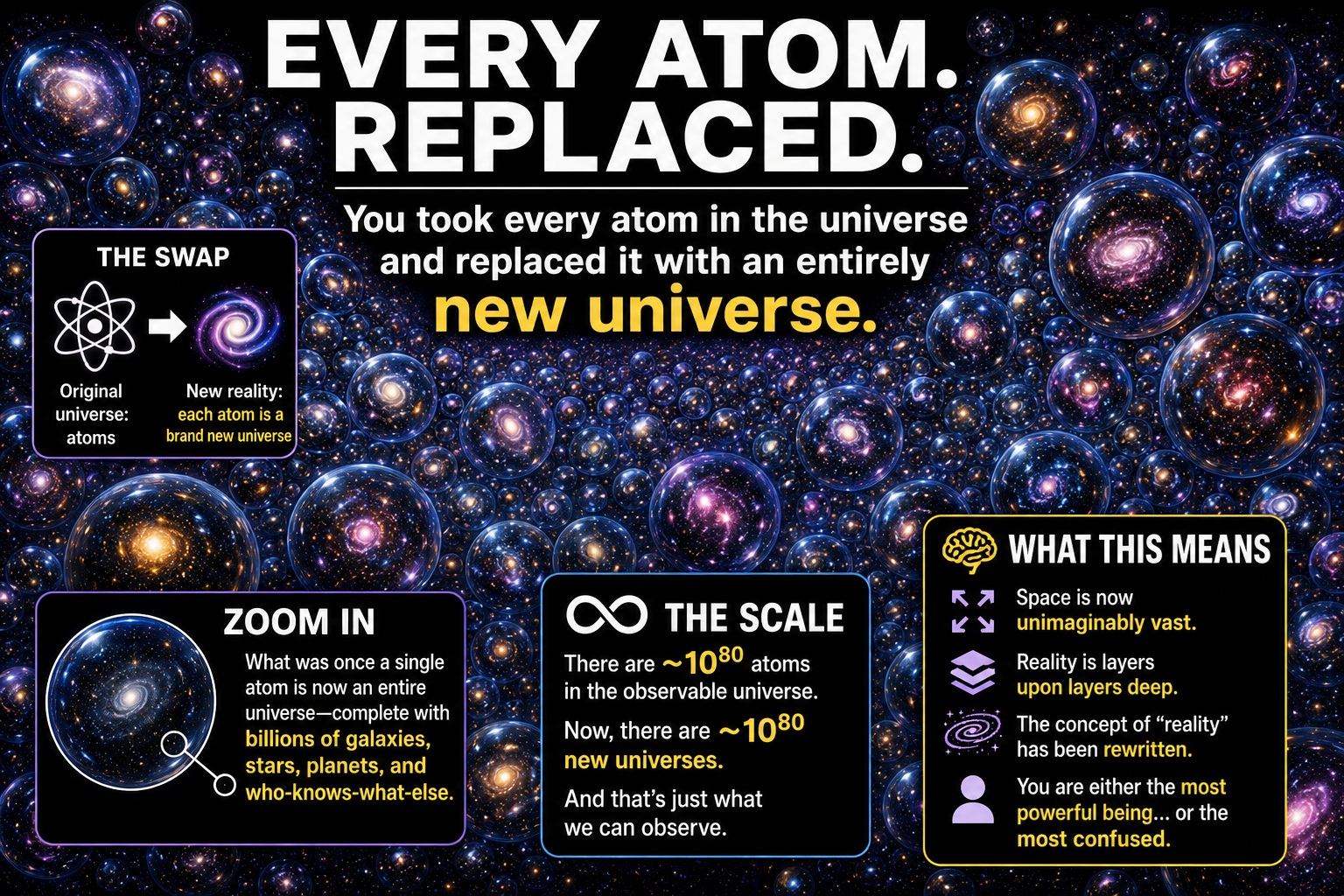
Now imagine that instead of counting atoms in the universe, you took every atom in the universe and replaced each one with an entirely new universe — each containing its own 10^80 atoms. Now count all of those atoms combined. You are approaching 10^160. We have left the boundary of anything physically meaningful. We are doing mathematics about things that cannot exist inside our universe because the universe is not large enough to contain them.
Step Three: Now Raise Ten to That Power
The Penrose number — 10^(10^123) — takes that incomprehensible quantity and uses it merely as an exponent. This is not a large number. This is a category of number for which human language has no adequate word. It is to ordinary large numbers what the entire observable universe is to a single electron.
The Combination Lock Analogy
 Imagine a
combination lock. A standard lock has perhaps ten thousand possible
combinations. The odds of cracking it randomly are one in ten thousand —
difficult, but conceivable.
Imagine a
combination lock. A standard lock has perhaps ten thousand possible
combinations. The odds of cracking it randomly are one in ten thousand —
difficult, but conceivable.
Now imagine a combination lock with not four dials, but 10^123 dials. Each dial has ten possible positions. To open the universe, every single dial had to land on exactly the right number — simultaneously — by chance.
That is what we are asking randomness to have accomplished at the moment of the Big Bang.
A master locksmith does not build a lock like that by accident. A universe does not open a lock like that by accident.
Something knew the combination before the lock existed.
CHAPTER THREE
The Control Panel
Six Knobs That Cannot Be Random
Imagine the universe has a control panel. On that panel are several knobs — each one controlling a fundamental force or constant of nature. Each knob can be set to an infinite range of values.
For life to exist, for atoms to form, for stars to burn, for planets to hold liquid water — every single knob must be set to a precise value. Not approximately. Not roughly. Precisely.
We will examine six of the most important.
Knob One: Gravity
Gravity is the force that pulls matter together — forming stars, holding planets in orbit, keeping your feet on the ground. It feels familiar. What is not familiar is how precisely it had to be tuned.
If the gravitational constant were stronger by just one part in 10^60, the universe would have collapsed back on itself within seconds of the Big Bang — before a single star could form. If it were weaker by a comparable fraction, matter would never have coalesced into anything — no stars, no planets, no chemistry, no life.
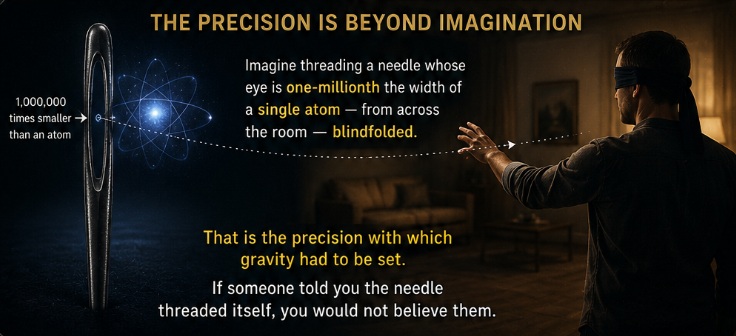
Imagine threading a needle whose eye is one-millionth the width of a single atom — from across the room — blindfolded. That is the precision with which gravity had to be set. If someone told you the needle threaded itself, you would not believe them.
Knob Two: The Cosmological Constant
The cosmological constant controls the rate at which the universe expands. Set too high and the universe expands so rapidly that matter never clumps together — no galaxies, no stars, no planets. Set too low and everything collapses under gravity before life has a chance to emerge.
The cosmological constant is fine-tuned to one part in 10^120. Physicist Leonard Susskind called it the most perplexing fine-tuning problem in physics. It is, by the numbers, the most precisely calibrated quantity in all of science.
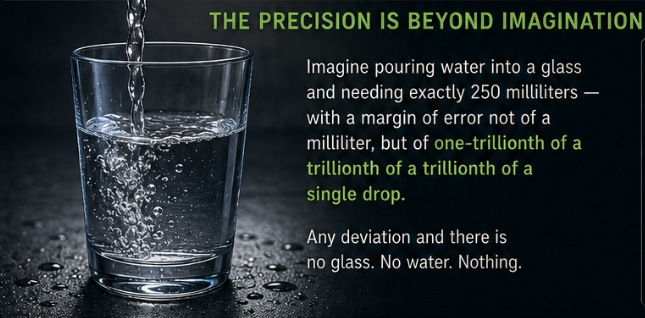
Imagine pouring water into a glass and needing exactly 250 milliliters — with a margin of error not of a milliliter, but of one-trillionth of a trillionth of a trillionth of a single drop. Any deviation and there is no glass. No water. Nothing.
Knob Three: The Strong Nuclear Force
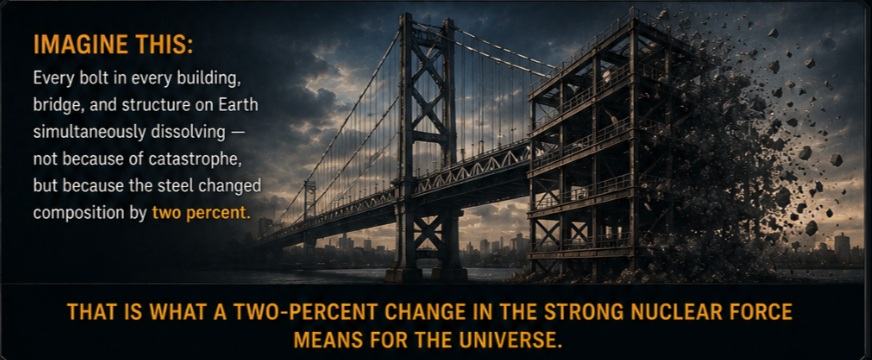
The strong nuclear force holds the nucleus of every atom together. Without it, atoms disintegrate instantly. Without atoms, there is no matter. Without matter, there is nothing at all.
If the strong nuclear force were weaker by just two percent, hydrogen — the most abundant element in the universe — could not form. No hydrogen means no water. No water means no life anywhere in the observable universe. Ever.
Imagine every bolt in every building, bridge, and structure on Earth simultaneously dissolving — not because of catastrophe, but because the steel changed composition by two percent. That is what a two-percent change in the strong nuclear force means for the universe.
Knob Four: The Ratio of Electrons to Protons
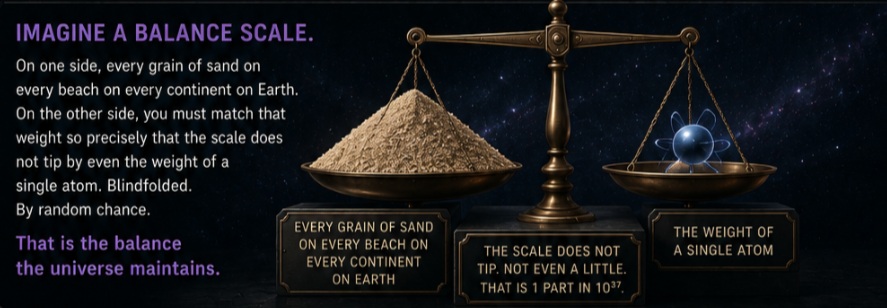
The number of electrons in the universe must match the number of protons to an accuracy of one part in 10^37. If it did not, electromagnetic forces would overwhelm gravity on astronomical scales, stars could not form, and the universe would be nothing but a sea of diffuse plasma.
Imagine a balance scale. On one side, every grain of sand on every beach on every continent on Earth. On the other side, you must match that weight so precisely that the scale does not tip by even the weight of a single atom. Blindfolded. By random chance. That is the balance the universe maintains.
Knob Five: The Speed of Light
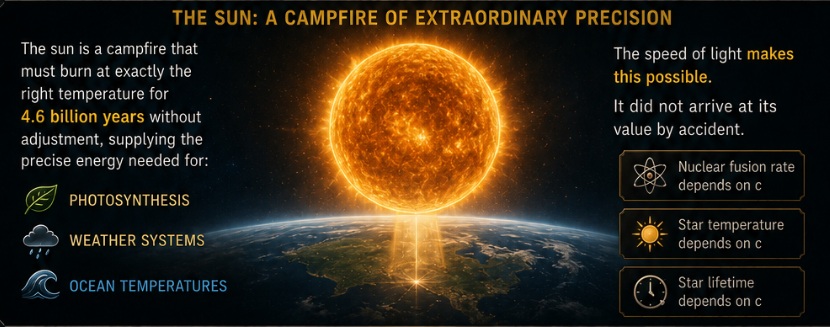
The speed of light determines how energy and matter interact through Einstein's famous equation E=mc². It governs the energy output of nuclear fusion — the process by which stars burn. Alter it and stars either burn out in thousands of years instead of billions, or never ignite at all.
The sun is a campfire that must burn at exactly the right temperature for 4.6 billion years without adjustment, supplying the precise energy needed for photosynthesis, weather systems, and ocean temperatures simultaneously. The speed of light makes this possible. It did not arrive at its value by accident.
Knob Six: The Mass of the Neutron
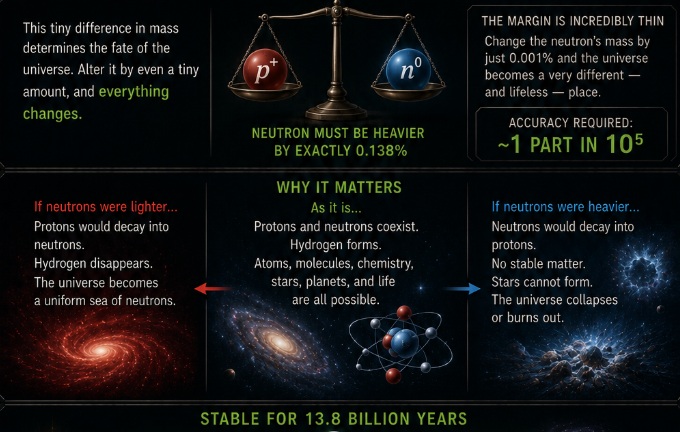
The neutron must be heavier than the proton by exactly 0.138 percent. Slightly lighter and all protons convert to neutrons, eliminating hydrogen and all chemistry. Slightly heavier by too much and the same collapse occurs in reverse. The margin is razor thin and the universe has stayed within it for 13.8 billion years.
The Combined Probability
Each of these constants operates independently. The probability of all of them falling into life-permitting ranges simultaneously — by chance — is not calculated by adding the individual odds. It is calculated by multiplying them.
Even being generously permissive with each individual calculation, the combined probability makes the Penrose number look modest.
The universe is not fine-tuned like a radio adjusted by hand. It is fine-tuned like a radio that assembled itself, then tuned itself to the exact right frequency, and broadcast — before anyone existed to turn it on.
|
Physical Constant |
Fine-Tuning Requirement |
|
Gravitational Constant |
Fine-tuned to 1 part in 10^60 |
|
Cosmological Constant |
Fine-tuned to 1 part in 10^120 — the most precise number in physics |
|
Strong Nuclear Force |
2% deviation eliminates hydrogen and all chemistry |
|
Electron-Proton Ratio |
Must match to 1 part in 10^37 |
|
Speed of Light |
Determines stellar energy output and the possibility of life |
|
Neutron Mass |
Must exceed proton mass by exactly 0.138% |
CHAPTER FOUR
Earth
The Original Vessel
Humanity is currently attempting to build a Mars colony ship — a vessel capable of carrying human life through the hostile vacuum of space. Our best engineers, our greatest institutions, trillions of dollars — all dedicated to solving what turns out to be an extraordinarily difficult engineering problem.
To sustain life in space you need, at minimum: a hull shielding inhabitants from radiation and temperature extremes; a water system that collects, recycles, and distributes water with zero loss; a food production system that operates indefinitely without resupply; an atmosphere maintained at exactly the right pressure, temperature, and chemical composition; a clean and constant energy source; navigation systems precise enough to maintain stable orbit; a population capable of self-sustaining reproduction; and an advanced information and computation system.
This is the hardest engineering challenge our civilization has ever attempted.
Now look at what you are standing on.
|
The Ship We Attempt to Build |
|
What Earth Already Has |
|
Radiation Shield |
↔ |
Magnetic field and atmosphere — blocks 99.9% of harmful radiation, self-maintaining for billions of years |
|
Water Recycling |
↔ |
The water cycle — evaporation, clouds, rain, rivers, oceans — zero loss, self-perpetuating, operating for four billion years without maintenance |
|
Food Production |
↔ |
Ecosystems — self-organizing networks that have fed every living thing for billions of years without a single scheduled service |
|
Atmosphere Control |
↔ |
A self-regulating system maintaining 21% oxygen, stable pressure, and temperature within life's range across geological timescales |
|
Energy Source |
↔ |
The sun — a nuclear fusion reactor 93 million miles away, delivering clean constant energy with zero infrastructure on our end |
|
Navigation |
↔ |
Orbital mechanics — Earth maintains a nearly circular orbit at precisely the right solar distance, stabilized by an unusually large moon |
|
Population |
↔ |
Eight billion humans and trillions of other organisms, all capable of reproduction without external assistance |
|
Information System |
↔ |
DNA — a self-reading, self-copying, self-repairing code of 3.2 billion base pairs in every cell of every organism |
|
Mission |
↔ |
Sustain, diversify, and evolve life across geological time — accomplished continuously for 3.8 billion years |
The Watchmaker Argument — Updated
The eighteenth-century philosopher William Paley proposed a thought experiment. Imagine walking through a field and finding a watch on the ground. You examine it. It keeps perfect time. Every gear serves a purpose. Every spring is calibrated. Would you conclude the watch assembled itself over millions of years from surrounding rocks?
Of course not. The watch declares a watchmaker.
Earth is not a watch. Earth is incomparably more complex than any watch ever made. Every system interlocks with every other. The oceans regulate temperature, which regulates the atmosphere, which enables photosynthesis, which produces oxygen, which allows animal life, which produces carbon dioxide, which feeds plant life, which regulates the oceans. Remove one and the chain breaks. The system does not merely function. It maintains itself, repairs itself, and has done so without interruption for nearly four billion years.
Humanity is attempting to engineer what Earth already is. We are not inventing. We are rediscovering principles that were in place before we existed.
CHAPTER FIVE
God's Source Code
The Impossibility of Accidental DNA
If you wanted to hide the most compelling evidence of divine intelligence in the universe, you would hide it in the smallest possible place.
It is hidden in every cell of your body.
What DNA Actually Is
DNA is not merely a chemical. It is information. It is a code — a language with a four-letter alphabet — written in sequences of three-letter words, forming instructions that tell your body how to build, operate, and repair itself across an entire lifetime.
The human genome contains 3.2 billion base pairs — 3.2 billion letters in the code. If you printed the human genome in standard book format, it would fill approximately 5,000 books of 600 pages each. A library. And unlike a library, which simply stores information, DNA executes its own instructions. It reads itself, copies itself, repairs itself when damaged, and transmits itself to the next generation with extraordinary fidelity.
No human engineer has built anything remotely approaching this. Our most advanced software requires teams of programmers, external hardware, and continuous maintenance. DNA operates autonomously, repairs itself, and has been running without a patch update for billions of years.
The Probability Calculation
Now we calculate. A protein is a chain of amino acids — the functional units of biology. A simple functional protein might contain 150 amino acids. There are 20 types of amino acids. For the protein to function, they must be in a specific sequence, like a password where every character matters and there are no partial credits.
Step One: The number of possible sequences for a 150-amino-acid chain is 20 raised to the power of 150:
20^150 ≈ 10^195
Possible amino acid sequences for a
single simple protein
Step Two: Of all those possible sequences, only an extraordinarily tiny fraction will fold into a functional protein. Researchers estimate approximately one in 10^77 sequences produces a working protein — and this is a generous estimate.
Step Three: The probability of one functional protein assembling by random chance:
1 in 10^164
Probability of a single functional
protein forming by random chance
Step Four: A simple living cell requires not one protein but approximately 2,000 different proteins, all present simultaneously, all working together as an integrated system.
The probability of that happening by random chance is a number so large it would require more pages to write than exist in all the books ever printed.
The Library Analogy
Imagine you take every letter of the alphabet, place them in a bag, and shake it vigorously. What is the probability that the letters fall out in the order of a complete, coherent, functional novel?
Essentially zero. Everyone accepts this without argument. We do not debate it.
DNA is not a novel. DNA is a library of 5,000 books. And each book is not merely coherent — it is executable. It does not describe how to build a human being. It builds one. From a single cell. In nine months. Without conscious guidance.
The bag of letters did not write the library. The bag of letters cannot write the library. An author wrote it.
CHAPTER SIX
Nature's Patent Office
God Invented It First
The patent office defines an invention as something novel — never done before. By that definition, strictly applied, humanity has never truly invented anything. We have only rediscovered what was already operating in nature — in most cases millions of years before we thought of it.
This is not a metaphor. It is a documented pattern that runs across the entire history of human technological development.
Sonar — 1906 vs. 34 Million Years
In 1906, Lewis Nixon invented sonar to detect icebergs. The military developed it through two World Wars into one of the most sophisticated detection systems ever built. Modern naval sonar can locate a submarine miles away, calculate its speed and depth, and distinguish it from marine life — all through sound waves bouncing off objects underwater.
Dolphins have been doing this for 34 million years.
A dolphin's biosonar — echolocation — emits clicks at frequencies up to 150,000 Hz, far beyond human hearing. The returning signals travel through the dolphin's lower jaw to its inner ear, where its brain constructs a three-dimensional image of its environment with a resolution that can distinguish a golf ball from a tennis ball in complete darkness at distances of 200 meters. The US Navy's best sonar arrays weigh tons and require ships to carry them. The dolphin's version weighs grams and is built into its face.
Flight — 1903 vs. 150 Million Years
When the Wright Brothers achieved powered flight in 1903, it was considered the greatest technological achievement of the age. The principles they employed — lift, drag, thrust, wing curvature — were worked out through years of meticulous experiment.
Birds have been flying for 150 million years. But consider what birds do that our aircraft still cannot replicate. A swift can sleep while flying — maintaining altitude, navigating, adjusting to wind — while unconscious. No autopilot approaches this. A bar-tailed godwit flies 11,000 kilometers non-stop from Alaska to New Zealand — nine days without landing, eating, or drinking — navigating by the Earth's magnetic field, the position of stars, and the angle of the sun, losing half its body weight in fuel, its organs shrinking mid-flight to reduce weight then regrowing upon landing. A peregrine falcon dives at 240 miles per hour and pulls out with G-forces that would cause a human pilot to lose consciousness, using a small beak notch aerospace engineers spent decades trying to understand.
We built planes. God built birds. Ours need runways, fuel, pilots, and scheduled maintenance. His navigate by stars, run on seeds, and have been airworthy for 150 million years without a single recall.
The Internet — 1990s vs. 500 Million Years
The internet is humanity's greatest information infrastructure — a network connecting billions of nodes, routing data around damage, distributing resources, enabling communication across planetary distances.
Beneath every forest floor is a mycelium network — a web of fungal threads connecting trees across acres of land. Trees use this network to share nutrients, send chemical warnings about insect attacks, and route food to dying seedlings that cannot yet reach sunlight. Scientists call it the Wood Wide Web. It has been operating for 500 million years. It has no servers. No cables. No power bills. It self-repairs, self-expands, and has never crashed.
Computers and AI — 1940s vs. Always
The most powerful supercomputer ever built performs approximately 10^18 calculations per second. It occupies the floor space of a tennis court, consumes enough electricity to power 21,000 homes, and cost $600 million to construct.
Your brain performs an estimated 10^15 to 10^17 operations per second — in a structure weighing three pounds, running on 20 watts — less power than a dim light bulb — that builds itself from a single cell, rewires itself based on experience, generates consciousness, creates art, feels love, asks questions about its own existence, and fits inside a human skull.
The supercomputer cannot do any of those last six things.
We are not inventors. We are students. The curriculum was written before we arrived.
|
Human Technology |
Nature's Prior Version |
|
Sonar |
Dolphin/bat echolocation — 34 million years |
|
Powered flight |
Birds — 150 million years |
|
Submarine ballast |
Fish swim bladder — 400 million years |
|
The internet |
Mycelium networks — 500 million years |
|
Computers and AI |
Human brain — operating since our emergence |
|
Honeycomb engineering |
Bees — 30 million years |
|
Hydraulics |
Muscular and circulatory systems — hundreds of millions of years |
|
Fiber optics |
Eye structure and bioluminescence — millions of years |
|
GPS / Navigation |
Bird magnetic field navigation — tens of millions of years |
|
Air conditioning |
Termite mounds — 25 million years |
CHAPTER SEVEN
The Encoded Manual
Ancient Words, Modern Discoveries
The Bible was written across approximately 1,500 years, completed roughly 2,000 years ago, by authors who had no microscopes, no particle accelerators, no knowledge of genetics, no concept of digital information, and no framework for understanding fractals, recursion, or forensic science.
And yet certain passages contain descriptions — specific, technical, verifiable — of phenomena that human science did not formally understand until the 19th and 20th centuries.
We will examine five.
Psalm 139:16 — The Description of DNA
"Your eyes saw my unformed body; all the days ordained for me were written in your book before one of them came to be."
Read this with the eyes of a molecular biologist.
"Your eyes saw my unformed body" — before birth, before form, there is a pre-existing record of what the body will become. This is precisely what DNA is: a complete blueprint of the organism encoded before the organism has taken physical shape. Every cell, every organ, every characteristic — written in advance.
"All the days ordained for me were written in your book" — the information is not merely structural but sequential. It describes a program that executes across a lifetime. This is exactly how DNA operates — not as a photograph of a finished organism, but as executable code that runs from conception to death, governing development, aging, immune response, and cellular behavior across an entire lifespan.
"Before one of them came to be" — the record precedes the reality. The code exists before the organism it describes. This is the defining characteristic of genetic information: the genome is complete at conception, before the body it will produce exists.
The structure of DNA was not discovered until 1953. The author of Psalm 139 wrote this approximately 3,000 years earlier.
Genesis 1:20 — Recursive Engineering
"Let the waters bring forth abundantly the moving creature that hath life."
The mechanism described here is self-generation from within the system itself. The waters do not receive creatures placed into them from outside — they bring them forth from within.
In computer science, recursion is a function that calls itself — producing output that becomes the input for the next iteration, generating increasing complexity from simple initial rules. It is one of the most powerful and elegant concepts in all of programming.
In biology, this is precisely how life elaborates. Simple organisms give rise to complex ones, each generation's output becoming the next generation's starting conditions, the system calling itself forward into greater complexity. The author of Genesis described the architecture without knowing the terminology. A programmer reading Genesis 1:20 would recognize the design pattern.
Genesis 2:21-22 — Cloning and Genetic Construction
"So the Lord God caused the man to fall into a deep sleep; and while he was sleeping, he took one of the man's ribs and then closed up the place with flesh. Then the Lord God made a woman from the rib he had taken out of the man."
For most of human history, this was read as narrative mythology. Then in 1996, Dolly the sheep became the first mammal cloned from adult somatic cells, and the passage acquired a different texture entirely.
What is described? Anesthesia — a deliberate induction of unconsciousness for a surgical procedure. Tissue extraction — a specific biological material taken from a living subject. Wound closure — the site is repaired after extraction. And construction of a complete new organism from the biological material of an existing one.
The rib is specifically mentioned. Bone marrow — found in ribs — is one of the richest sources of stem cells in the human body. Stem cells are the raw material of modern genetic medicine. CRISPR gene editing — the technology that allows scientists to extract genetic material and use it to construct or modify organisms — was developed in 2012.
The concept was described in Genesis thousands of years before the technology existed to understand what was being described.
Job 37:7 — Biometric Identification
"He seals the hand of every man, that all men whom he has made may know it."
Job is among the oldest books in the Bible — potentially written as far back as 2,000 BCE. The verse describes a unique seal placed on every human hand.
In 1892 — approximately 3,900 years after Job was written — Francis Galton published the first scientific study proving that every human fingerprint is unique. No two people in the history of humanity have ever had the same fingerprint. Not identical twins. Not any of the 108 billion humans who have ever lived.
Today we use this seal to unlock devices, clear borders, identify criminals, and authenticate identity across every major security system on Earth. Job called it God's signature on every human hand. He was not wrong. He was simply writing in a language that predated forensic science by four thousand years.
Matthew 10:30 — Fractal Design and Infinite Resolution
"And even the very hairs of your head are all numbered."
Fractal geometry — developed by Benoit Mandelbrot in the 1970s — is the mathematics of structures that repeat their pattern at every scale of magnification. Nature is saturated with fractals: the branching of trees mirrors the branching of rivers mirrors the branching of blood vessels mirrors the branching of neurons mirrors the branching of lightning.
What Matthew 10:30 describes — in the context of fractal mathematics — is infinite granularity of divine knowledge. Not merely that God knows you exist, but that the enumeration extends to the smallest, most individually specific detail of your physical existence.
This is a description of a system with infinite resolution — a design maintaining its specificity and awareness at every level of magnification. In computational terms, it describes a system with lossless information retention at all scales. In fractal terms, it describes a pattern that never loses resolution no matter how far you zoom in.
The hairs of your head are numbered. The 37 trillion cells of your body are numbered. The 7 times 10^27 atoms of those cells are numbered. A universe run by an intelligence with total informational awareness at every scale of resolution is exactly what a programmer running a simulation would possess.
|
Biblical Verse and Approximate Date |
Modern Scientific Concept Described |
|
Psalm 139:16 (~1000 BCE) |
DNA as pre-written biological code — discovered 1953 |
|
Genesis 1:20 (~1400 BCE) |
Recursive self-generating systems — formalized in computer science, 20th century |
|
Genesis 2:21-22 (~1400 BCE) |
Stem cell extraction and organism construction — CRISPR developed 2012 |
|
Job 37:7 (~2000 BCE) |
Unique biometric identification — fingerprint science, 1892 |
|
Matthew 10:30 (~30 CE) |
Fractal design and infinite-resolution enumeration — fractal geometry, 1975 |
CHAPTER EIGHT
Consciousness
The Ghost That Science Cannot Find
Of all the mysteries science has encountered, consciousness is the one that refuses to yield. Not because we lack instruments. Not because we lack intelligence. But because consciousness — by its very nature — sits outside the boundary of what material science can explain.
This problem is so significant that philosophers and scientists gave it a formal name: The Hard Problem of Consciousness.
What the Hard Problem Actually Means
Science has made extraordinary progress explaining the brain. We can map neural pathways. We can identify which regions activate during emotion, memory, and decision-making. We can measure electrical impulses at millisecond resolution and identify the specific neurotransmitters involved in every mood state.
What science cannot explain — at all — is this: why does any of it feel like anything?
When you see the color red, there is a wavelength of light at approximately 700 nanometers entering your eye, triggering photoreceptors, sending electrical signals to your visual cortex. All of that is measurable. All of that is chemistry and electricity.
But why is there an experience of redness? Why is there something it feels like to see it? Why does the processing not happen in darkness — the way a calculator processes inputs without anyone home to witness the result?
Even a complete explanation of brain function leaves untouched the question of why there is subjective experience at all. Why is there an inside view? Why is there a you?
No arrangement of neurons has ever been shown to generate interior experience. We can correlate brain states with mental states with increasing precision. We cannot explain how or why physical processes produce awareness.
Neuroscientist Christof Koch spent decades pursuing the neural correlates of consciousness and concluded that the more he studied the brain, the more mysterious consciousness became. He proposed that consciousness may be a fundamental property of the universe — not something the brain generates, but something the brain accesses.
The Radio Analogy
A radio does not produce music. It receives it. The music exists independently of the radio. Destroy the radio and the transmission does not cease — only your ability to receive it does.
If the brain is a receiver of consciousness rather than its generator, then consciousness exists independently of the physical body. It existed before the body assembled. It continues after the body stops functioning.
This is not mysticism. It is the direction the evidence points.
The Quantum Observer Problem
In quantum mechanics — our most precise and experimentally verified description of physical reality — particles do not have definite properties until they are observed. Before measurement, a particle exists in a superposition of all possible states simultaneously. The act of conscious observation collapses it into a single definite state.
This is not interpretation. This is the experimentally confirmed foundation of quantum mechanics, verified to extraordinary precision across thousands of experiments over a century.
The implications are staggering: the universe requires a conscious observer to collapse from possibility into reality. Without consciousness, the universe remains a cloud of probability. Consciousness is not a passenger in the universe. According to quantum mechanics, consciousness is a participant in the creation of physical reality.
Physicist John Wheeler concluded from this that the universe is fundamentally participatory. He proposed the universe did not produce consciousness as a late-stage byproduct. Consciousness was there first. The universe was designed by, and for, conscious experience.
There is a word for an infinite, fundamental consciousness that underlies all physical reality, from which all existence emerges. Every spiritual tradition has used it.
CHAPTER NINE
Dispatches from Beyond
The Clinical Evidence for Consciousness After Death
If consciousness exists independently of the brain — if it is received rather than generated — then we would expect that when the brain ceases to function, consciousness might continue. This is precisely what a substantial and growing body of clinical evidence shows.
What Near-Death Experiences Are — and Are Not
A near-death experience occurs when a person is clinically dead — no heartbeat, no measurable brain activity — and is subsequently resuscitated, reporting coherent, detailed experiences that occurred during the period of clinical death.
These are not dreams. Dreams occur during sleep, a state of reduced but present brain activity. NDEs occur when brain activity has flatlined. By the standard neuroscientific model — which holds that consciousness is produced by the brain — NDEs should be neurologically impossible. You cannot have vivid, coherent experience when the organ that allegedly produces experience is not operating.
And yet.
The Scale of the Evidence
A landmark study published in The Lancet — one of the world's most prestigious medical journals — followed 344 cardiac arrest patients who were successfully resuscitated. Of these, 18 percent reported near-death experiences: coherent, detailed experiences during the period of clinical death. The researchers, led by cardiologist Pim van Lommel, concluded the data could not be explained by existing neuroscientific models.
The AWARE study, led by Dr. Sam Parnia at Southampton University, placed images on high shelves in cardiac resuscitation rooms — images visible only from above, near the ceiling. Patients who reported out-of-body experiences during cardiac arrest accurately described these images and details of their resuscitation that they could not have observed from their position on the table, unconscious.
Dr. Eben Alexander — a neurosurgeon at Harvard Medical School — contracted bacterial meningitis that destroyed his neocortex: the region responsible for all conscious thought and experience. His brain was not merely inactive. It was being actively destroyed by bacterial infection. He was in a coma for seven days. During that time, conscious experience as his training defined it was neurologically impossible. He reported a detailed, coherent, transcendent experience. He spent years afterward attempting to find a neurological explanation. He could not.
The Signature of Consistency
Across thousands of documented cases, from cultures with no knowledge of each other, across centuries of recorded history, NDEs share a remarkable consistency of structure:
◆ Leaving the body and observing it from above with accurate perception of the physical environment
◆ Moving toward a source of light of described overwhelming intensity and warmth
◆ Encountering a presence of profound intelligence and unconditional love
◆ A complete life review — experiencing every moment of one's life, including its impact on others, with perfect clarity
◆ Encountering deceased relatives, sometimes relatives unknown to the experiencer during their lifetime
◆ Returning with a complete and permanent loss of fear of death
◆ Returning with a transformed sense of purpose and a deepened capacity for love
These features appear in NDEs reported in the United States, India, China, tribal Africa, medieval Europe, and ancient Egypt. They appear in children too young to have absorbed cultural narratives about death. They appear in people who were blind from birth — who report, for the first time in their lives, the experience of vision.
If NDEs were hallucinations produced by a dying brain, they would be as varied as dreams — shaped by individual neurology and cultural expectation. Instead they are structurally identical across all cultures and all eras of human history.
There is one explanation that accounts for all the data: consciousness survives physical death. What is experienced is not a malfunction of the dying brain. It is the experience of consciousness continuing — and briefly glimpsing — what lies beyond the physical.
The near-death experience is not an anomaly. It is a preview.
CHAPTER TEN
The Mathematics of Prophecy
Calculating the Odds of the Bible's Accuracy
The Bible contains hundreds of specific, falsifiable predictions about future events. Unlike the vague pronouncements of ordinary soothsayers — which can be bent to fit almost any outcome — these prophecies are specific, named, geographically situated, and verifiable against independent historical record.
The question is not theological. It is mathematical: what is the probability that these predictions were accurate by chance?
The Method
Mathematician and professor Peter Stoner applied standard probability theory to biblical prophecy in his work Science Speaks, reviewed and endorsed by the American Scientific Affiliation. His method was straightforward: assign a conservative probability to each prophecy being fulfilled by chance, then multiply them. We will examine the most verifiable.
The Destruction of Tyre — Ezekiel 26, Written ~590 BCE
Ezekiel made six specific predictions about the city of Tyre: Nebuchadnezzar would destroy the city; other nations would participate; the city would be made bare like a rock; its stones and timber would be thrown into the sea; it would become a place for spreading fishing nets; it would never be rebuilt as a major city.
What happened: Nebuchadnezzar besieged and destroyed Tyre in 573 BCE — fulfilling prediction one. Two hundred years later, Alexander the Great demolished what remained and threw the rubble — stones, timber, dust — into the sea to build a causeway to the island fortification, fulfilling predictions two, three, and four. The site was never rebuilt. Fishermen used the rocky remnant to spread their nets — fulfilling five and six.
Stoner's conservative probability of all six occurring by chance: one in 75 million.
The Fall of Babylon — Isaiah 13 and Jeremiah 50, Written ~700-600 BCE
Specific predictions: Babylon would fall to the Medes; it would never be inhabited again; Arabs would not pitch tents there; shepherds would not rest their flocks there. Babylon fell to the Medes and Persians in 539 BCE. The city declined over subsequent centuries. The ruins sit in modern Iraq — uninhabited, avoided in local tradition, no dwelling place, no shepherding ground.
Stoner's conservative probability: one in ten billion.
The Messiah — Written 400 to 1,000 Years in Advance
The Old Testament contains dozens of specific predictions about the Messiah. Consider eight:
|
Prophecy |
Source → Fulfillment |
|
Born in Bethlehem |
Micah 5:2 (~700 BCE) → Matthew 2:1 |
|
Preceded by a messenger |
Malachi 3:1 (~400 BCE) → Matthew 11:10 (John the Baptist) |
|
Entered Jerusalem on a donkey |
Zechariah 9:9 (~500 BCE) → Matthew 21:1-11 |
|
Betrayed by a friend |
Psalm 41:9 (~1000 BCE) → Matthew 26:47-50 |
|
Betrayed for 30 pieces of silver |
Zechariah 11:12 (~500 BCE) → Matthew 26:15 |
|
Silver used to buy a potter's field |
Zechariah 11:13 (~500 BCE) → Matthew 27:6-7 |
|
Silent before accusers |
Isaiah 53:7 (~700 BCE) → Matthew 27:12-14 |
|
Hands and feet pierced |
Psalm 22:16 (~1000 BCE) → John 20:25 |
Note regarding Psalm 22:16: this verse describes the piercing of hands and feet. It was written approximately 1,000 years before crucifixion was invented as a method of execution. The author could not have known the method. Only the result.
Stoner's probability of one person fulfilling all eight by chance: one in 10^17. To make this tangible: it is the equivalent of covering the entire state of Texas two feet deep in silver dollars, marking one of them, mixing all of them, blindfolding a person, and asking them to reach down and select the marked coin — on the first try.
1 in 10^157
Probability of one person fulfilling 48
Messianic prophecies by chance
The same standard that tells us the universe could not have self-assembled tells us the Bible could not have self-predicted. Something knew what was coming.
CHAPTER ELEVEN
The Anthropic Principle
The Universe Knew We Were Coming
In 1973, physicist Brandon Carter formulated what he called the Anthropic Principle — the observation that the universe's physical constants and initial conditions appear to have been selected for the existence of conscious life. Not merely compatible with life. Oriented toward it.
The Standard Dismissal — and Why It Fails
The most common scientific response to fine-tuning is the Anthropic Selection Effect: we can only observe a universe compatible with our existence, so it is unsurprising that it appears fine-tuned for us. If it were not, we would not be here to notice.
This sounds compelling. It is not.
Imagine you are brought before a firing squad of one hundred expert marksmen. They all fire. They all miss. You are alive.
The selection effect argument says: of course they all missed — if they had not, you would not be here to observe it. Therefore the fact that they all missed requires no explanation.
But this is wrong. The fact that you survived to observe it does not explain why you survived. It does not explain why one hundred expert marksmen missed simultaneously. That still requires an explanation.
The selection effect tells us why we can only observe life-permitting universes. It does not explain why a life-permitting universe exists. These are different questions. The first is trivially answered. The second is not answered at all.
The Multiverse — The Last Resort
The dominant scientific alternative to design is the multiverse hypothesis: the proposal that our universe is one of an infinite number, each with different physical constants. In an infinite ensemble, any combination of constants will eventually occur by chance — including ours.
Three problems make this an inadequate substitute for design. First, it is not science. A hypothesis that cannot be tested, observed, or falsified does not qualify as a scientific theory. Other universes, by definition, leave no observable evidence. The multiverse is philosophy dressed in scientific language.
Second, it does not eliminate the design problem — it relocates it. If a mechanism generates infinite universes with varying constants, what designed that mechanism? What set the parameters of the universe-generator? The fine-tuning problem simply moves up one level, requiring an Architect capable of designing not just a universe but a multiverse.
Third, it requires more unsupported assumptions than the alternative it attempts to replace. To avoid concluding that our universe was designed, we must believe in an infinite number of unobservable universes — with no evidence whatsoever. This is not scientific parsimony. It is philosophical desperation.
The Goldilocks Planet
Bring the Anthropic Principle down from the cosmic to the local.
Earth does not merely permit life. Earth appears to have been optimized for it. The distance from the sun — within the narrow habitable zone where liquid water is possible. The size of the Moon — unusually large relative to Earth, stabilizing our axial tilt at 23.5 degrees, preventing the chaotic temperature swings that would prevent complex life. The position of Jupiter — acting as a gravitational shield, capturing asteroids and comets that would otherwise sterilize Earth at a rate incompatible with the development of complex life. Our position in the galaxy — in the galactic habitable zone, far enough from the dangerous radiation of the galactic center, close enough to the heavy elements that rocky planets and biology require.
Not one of these conditions is required by physical law. Each could have been otherwise. Each happens to be exactly right.
The constants of physics were set 13.8 billion years ago. Life did not appear until 3.8 billion years ago. Conscious life appeared only recently. The universe was fine-tuned for an outcome that would not manifest for ten billion years. That is not chance. That is a plan.
CHAPTER TWELVE
The Simulation
Ancient Truth in Modern Language
In 2003, Oxford philosopher Nick Bostrom published a paper arguing — through pure logic — that we almost certainly live in a simulation created by a higher intelligence. The reasoning was straightforward: any civilization sufficiently advanced will eventually create simulations of conscious experience. If even one such civilization exists, the number of simulated realities will vastly outnumber the one base reality. Therefore the probability that we occupy the base reality is vanishingly small.
This is a philosophical argument. The physics has begun to support it.
The Code in the Equations
Physicist S. James Gates Jr., while working on string theory — our deepest current mathematical description of reality — discovered something that stopped him cold. Embedded in the equations that describe the fundamental structure of the universe, he found error-correcting codes. Not metaphorically. Literally. Specifically, a class of code called doubly-even self-dual linear binary error-correcting block codes — the same family of codes used to ensure accurate data transmission in computer browsers and digital communications.
In other words: the mathematical fabric of physical reality contains the same type of code that a programmer writes to make sure a computer runs without errors.
Gates himself said he did not know what to make of it. But anyone willing to follow the implication cannot avoid it: the universe appears to be running on something. And something wrote the code.
What Different Languages Call the Same Thing
|
The Language of Physics |
The Language of Theology |
|
The Programmer |
God |
|
The Simulation |
Creation |
|
The Source Code |
The Word / Logos |
|
Initial parameters |
"Let there be light" |
|
Error-correcting code |
Providence / Divine order |
|
Outside the simulation |
Transcendence |
|
The rules of physics |
Natural law / God's law |
|
Conscious observer |
The soul |
|
End of the simulation |
Judgment / Eternity |
The language changed. The reality it points to did not.
A being of incomprehensible intelligence, existing outside of time and space, who designed a reality with intention and precision, who embedded order into the fabric of existence, who can observe every level of the system simultaneously — every major spiritual tradition has described this being. Modern physics is independently arriving at the same description through equations.
CHAPTER THIRTEEN
Preinstalled Infrastructure
Memory, Identity, and the Architecture of Return
Evolution, by definition, only produces features that offer survival or reproductive advantage in the present. It cannot plan ahead. It cannot build infrastructure for needs that do not yet exist. It has no foresight. It responds only to immediate selective pressure.
With that principle established, we encounter two features of human biology that have no satisfactory evolutionary explanation — but have a perfect explanation if you are willing to consider that they were installed by design, for a purpose that extends beyond this single life.
Part One: Memory — The Recording System No Evolution Ordered
The human brain's memory system is extraordinary in its capacity and design. Conservative estimates suggest the brain can store approximately 2.5 petabytes of information — equivalent to three million hours of continuous video recording. But raw storage capacity is only the beginning.
Human episodic memory does not merely store facts. It stores experience. When you remember a significant moment from your past, you do not retrieve a data file. You re-enter a moment. The light in the room. The smell in the air. The emotional texture of what you felt. The specific quality of who you were at that instant in time.
This is extraordinary. It is also, from the perspective of evolutionary utility, completely unnecessary.
What Evolution Can Justify
Procedural memory — how to walk, how to use tools — has obvious survival value. Semantic memory — what is dangerous, what is edible — clearly helps survival. Short-term episodic memory — did I eat from that plant recently and get sick? — has marginal survival utility.
What evolution cannot justify is the elaborate, emotionally rich, lifelong, first-person narrative recording system that human beings carry. Why does a seventy-year-old retain vivid memories of childhood moments that have no bearing on any current survival decision? Why does the brain store the emotional texture of a first love, the grief of a particular loss, the specific quality of an afternoon decades gone? None of that helps find food, avoid predators, attract a mate, or raise offspring.
By evolutionary logic, it is metabolically expensive excess. And yet the system storing it is among the most sophisticated structures in the known universe.
The Reincarnation Infrastructure Argument
If consciousness survives physical death — as the clinical evidence in Chapter Nine demonstrates — and returns to physical existence in a new form, as traditions across virtually every culture in human history have described, then something must carry the record of who you were.
Not behavioral tendencies. Not vague impressions. The full, rich, continuous, first-person narrative — the memories, the relationships, the lessons, the identity — that constitutes a self.
For reincarnation to be meaningful, there must be a recording system capable of storing a complete human life in a form that survives the death of the physical body. The brain, in its physical form, does not survive death. But if the brain accesses rather than generates consciousness and memory — if it is a terminal connected to a substrate that does persist — then the record survives even when the terminal does not.
Why would evolution build a system that records more than survival requires? It would not. It could not. But a designer who knew that consciousness would return — who built the infrastructure of identity to persist beyond death — would build exactly this.
The recording was not built for this life. It was built for the continuity across all lives.
Part Two: Fingerprints — The Serial Number Stamped Before Forensic Science Existed
Fingerprints — the unique dermal ridge patterns on human fingertips — have no demonstrated biological function that justifies their existence from an evolutionary standpoint.
The most frequently offered explanation is grip improvement. This has been tested. A 2009 study at the University of Manchester found that fingerprint ridges actually reduce contact area between fingertip and smooth surfaces — meaning they may slightly reduce grip on smooth objects. On rough surfaces, any simple skin texture would provide comparable friction without the elaborate unique-pattern system.
And yet:
◆ Every human being who has ever lived has had them
◆ Every fingerprint across 108 billion people across hundreds of thousands of years has been unique — no two identical, ever
◆ They form in the womb at ten weeks gestation — before the nervous system is complete, before most biological systems are operational — as if the body considers this a priority
◆ They are permanent — unchanged from womb to death, regenerating after injury, resistant to deliberate removal
◆ The genome contains specific instructions to generate uniqueness — this is not an accident of development; it is a specification
The Forensic Science Argument
Francis Galton proved the uniqueness of fingerprints in 1892. The first criminal conviction based on fingerprint evidence came in 1902. Today fingerprints authenticate identity across criminal forensics, border control, financial systems, and personal devices across every nation on Earth.
Now ask the precise question: why did the human genome contain instructions to generate unique permanent identifiers — hundreds of thousands of years before the civilization capable of reading them existed?
Evolution builds for the present. It has no mechanism for anticipating a future civilization's need for individual identification and accountability. And yet here is the identifier — permanent, unique, unforgeable, installed at ten weeks of gestation, regenerating if damaged — waiting patiently for the civilization sophisticated enough to read it.
This is not evolution. This is the same logic as finding a USB port on a device built before USB was invented. The port has no function yet. But it was placed there because something knew USB was coming. The fingerprint has no survival function. But it was placed there because something knew forensic science — and cosmic accountability — was coming.
Part Three: The Combined Argument — Infrastructure for a Future That Was Already Known
Place these two observations side by side.
Memory: a recording system of extraordinary richness and capacity, far exceeding any survival requirement, storing the complete first-person narrative of a human life. Installed in every human being. Built to record more than this life requires.
Fingerprints: a unique, permanent, unforgeable individual identifier, with no biological survival function, installed at ten weeks of gestation in every human being. Built to identify individuals across time in ways that a future civilization would require.
Both features share one defining characteristic: they only make complete sense in a context beyond this life and this era.
Memory makes complete sense if consciousness returns — if the record of who you were must be carried forward into who you will become.
Fingerprints make complete sense if individual human beings are permanently, uniquely accountable — not just to forensic science, but to a system of record-keeping that tracks every soul across every lifetime.
They were not built for this life. They were built for the full arc of existence — across whatever number of lives a soul is meant to live. And they were installed before the need for them was visible to anyone — except the one who designed them.
Job 37:7 was not poetry. It was a technical specification. Written 3,900 years before the civilization arrived that could read it.
CHAPTER FOURTEEN
The Logical Proof
Premises, Evidence, Conclusion
We have examined eight independent lines of evidence. Each was developed through a different scientific discipline. None was coordinated with the others. All arrive at the same place.
Let us now state the complete argument as a formal logical proof — the way a mathematician or philosopher would present it — so that it can be examined, tested, and challenged.
The Formal Argument
|
|
The Argument |
|
Premise 1 |
Extreme, specified, complex organization cannot arise from random processes. This is demonstrated by information theory, thermodynamics, and probability mathematics. No observed instance of random processes generating functional specified complexity exists in science. |
|
Premise 2 |
The universe at every examined level — its initial conditions, its fundamental constants, its biological structures, its information systems — exhibits extreme specified complex organization. |
|
Premise 3 |
The probability calculations across multiple independent disciplines confirm that randomness is not a viable explanation for what we observe. The numbers are not ambiguous. |
|
Premise 4 |
Consciousness is a fundamental feature of reality, not a byproduct of it. It cannot be explained by material processes and is demonstrated by clinical evidence to be independent of the physical brain. |
|
Premise 5 |
The Bible contains specific technical information that its human authors could not have possessed. The probability of this accuracy by chance matches the probability calculations from physics: effectively zero. |
|
Premise 6 |
Human biology contains features — memory architecture and unique biometric identification — that serve no evolutionary purpose but serve obvious purpose in a framework of continued consciousness and cosmic accountability. |
|
Conclusion |
Therefore: an intelligence of incomprehensible capability designed the initial conditions, wrote the rules, built the biological systems, encoded knowledge in the ancient texts, and installed infrastructure in human beings for a continuity of existence that extends beyond this life. |
This is not a leap of faith. It is the same logical structure used in every scientific investigation. When archaeologists find a carved arrowhead, they do not conclude the stone shaped itself. They conclude an intelligence shaped it — because the organization of the stone exceeds what random processes produce.
The universe is the arrowhead. The question of who carved it has one logical answer.
What we call that intelligence is secondary. God, the Architect, the Programmer, the Source — these are words pointing at the same reality. A reality that the mathematics of our own universe insists upon.
CHAPTER FIFTEEN
Why This Matters
The Moral Architecture of a Designed Universe
Science tells us what and how. It has never been able to tell us why. Why does anything exist rather than nothing? Why does the universe permit life? Why does consciousness exist — the ability to look at a sunset and find it beautiful, to feel the specific weight of grief, to know the difference between right and wrong and feel the difference in your body?
These questions cannot be answered by a periodic table or a particle accelerator. But they are answered — consistently, across every culture and every era of human history — by the recognition of a Creator.
Two Worlds, Two Outcomes
The answer to the question of design is not merely intellectual. It carries moral weight that shapes civilizations.
If the universe is the product of random, purposeless forces, then human life has no intrinsic value — it is a chemical accident on an unremarkable planet in an indifferent cosmos. Morality becomes preference, not truth. There is no ultimate accountability. Meaning is something each person manufactures in isolation, and it dies with them.
If the universe was designed — if there is an Architect — then life has intrinsic value because it was intended. Morality reflects the nature of the Designer — right and wrong are real because they are grounded in something that does not change. Actions carry consequence beyond the physical. Meaning is built into the fabric of existence, not invented by us.
Fyodor Dostoevsky — perhaps the most psychologically penetrating novelist who ever lived — put it plainly: without God, everything is permitted. He did not mean this as a celebration. He meant it as a warning. The twentieth century — the most violent in human history, driven largely by ideologies that explicitly rejected the transcendent — demonstrated with terrible precision what he meant.
What This Book Is Not Saying
This book does not argue for any particular religion. It does not claim that one tradition has a monopoly on the truth it points toward. The evidence presented here is equally available to the Christian, the Muslim, the Jew, the Hindu, the Buddhist, and the person who has never set foot in a house of worship but feels, in their bones, that something is here.
The argument is simpler and deeper than any single tradition: we did not create ourselves. We exist within something larger. The precision with which that something was designed — down to the fingerprints on our hands and the memory architecture in our minds — suggests we are not here by accident, and we are not here without purpose.
This is not an argument for religion. It is an argument for the foundation upon which all meaningful moral and spiritual frameworks rest — the recognition that existence is not an accident.
THE ULTIMATE TRUTH
What the Universe Has Been Saying All Along
We have traveled far in these pages. We have looked at the universe from its first moment — the extraordinary, impossible precision of its beginning. We have examined the constants of physics and found them calibrated to a degree that makes chance a mathematical absurdity. We have looked at the biology of life and found information systems of staggering complexity that no random process can account for.
We have looked at the natural world and discovered that every technology our civilization considers an invention was already operational in biology — more elegantly, more efficiently, more durably than anything we have built. We have examined specific passages of an ancient text and found technical descriptions of phenomena the authors could not have understood, written thousands of years before the science to understand them existed.
We have followed the evidence for consciousness beyond the brain, for personal identity persisting beyond death, for a universe oriented not accidentally but deliberately toward the emergence of aware, experiencing, questioning beings.
And we have found, in the very architecture of the human body, evidence of infrastructure installed in advance — a recording system built to carry identity beyond this life, an identification system built to hold every soul accountable across all lives — placed there before the civilization arrived that could read either.
We live in something so precisely engineered
that the word fine-tuned is insufficient.
We live in something so ordered
that randomness — by its own mathematics — cannot account for it.
We live inside a design.
Behind every design is a designer.
That designer — whatever name your language,
culture, or tradition gives it —
is what this universe has been quietly, mathematically,
insistently pointing to since the moment it began.
The numbers are not uncertain.
The logic is not ambiguous.
The conclusion is not a matter of faith.
It is a matter of following the evidence —
all the way to the end.
"If we can imagine it,
a greater intelligence has already done it."
And we are only beginning to understand what it has done.